
Have you ever felt frustrated by a lack of progress in your dental practice? The secret often lies in your team’s accountability. Imagine your practice with every staff member taking responsibility, doing what they say they will do, and holding each other accountable. Read the following five strategies to make that a reality.
What is Accountability?
Two dictionary definitions of accountability are as follows:
Cambridge Dictionary
‘the fact of being responsible for what you do and able to give a satisfactory reason for it, or the degree to which this happens’
Oxford Dictionary
‘the fact of being responsible for your decisions or actions and expected to explain them when you are asked’
When I think about accountability in a dental practice I see it on two levels.
- You do what you say you will do.
- You take responsibility for your actions or decisions.
If you have a culture of accountability in your dental practice, you have a team of people who follow through and do what they say they will do. You also have a team of people who take responsibility for their actions. They look at themselves and what they did, rather than blaming others.
Here are the 5 strategies to develop that culture:
Developing a level of trust and psychological safety
Trust & psychological safety are the foundation of any high-performing team. They are essential to creating a culture of accountability in a dental practice.
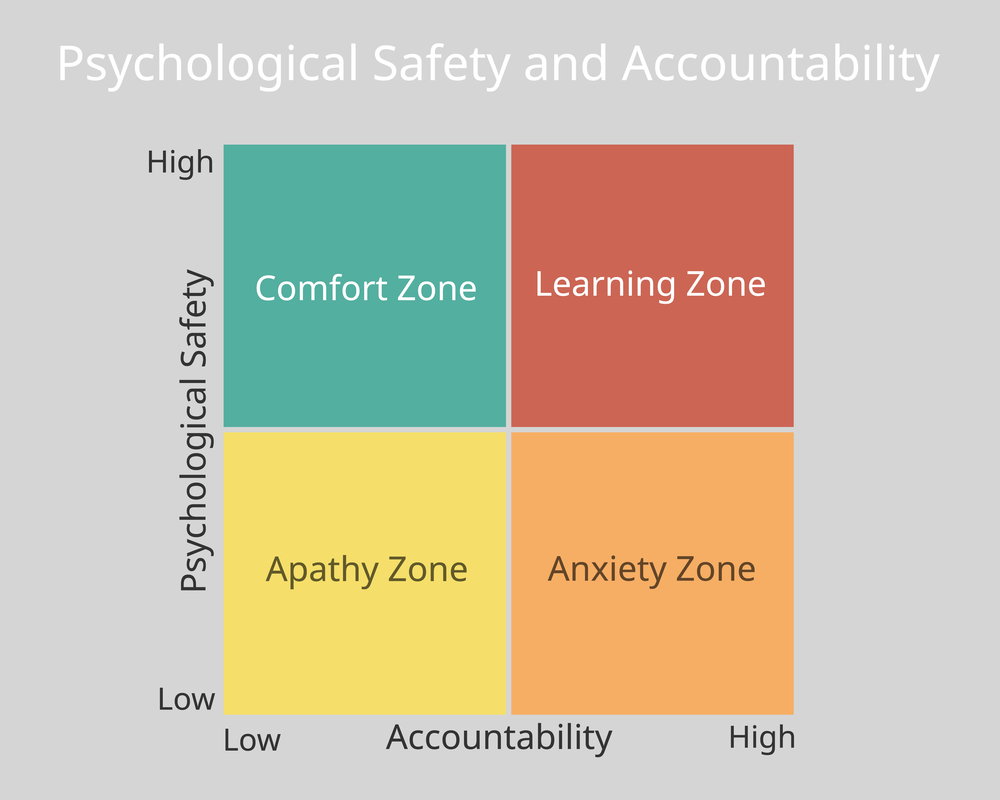
In his book, The Five Dysfunctions of a Team, Lencioni discusses a type of trust where team members know they can address difficult topics, be open about mistakes, admit weaknesses, celebrate successes, seek assistance, challenge one another, and generally be vulnerable. They do not fear negative interpersonal repercussions for doing so. Essentially, they feel safe engaging in these actions, which fosters accountability for both their individual performance and the overall success of the team to which they belong.
The term ‘psychological safety’ refers to an environment devoid of such fears. In her book The Fearless Organization, Amy Edmondson elaborates extensively on the significance and effects of this type of environment.
A research study by Google, called Project Aristotle, examined what specifically contributes to high-performing teams. The researchers analysed 130 different teams across Google to identify which factors were most crucial to performance. By far, the single most significant factor was psychological safety.
If individuals in the team do not feel this way, they will not challenge viewpoints, ask for help or admit mistakes, and instead will remain quiet, not follow through on actions and blame others. A culture of accountability won’t be possible.
To create an environment of psychological safety in your dental practice:
- be genuinely open and curious about what your team are saying to you
- listen
- ensure the team is also behaving in the same way with each other
- Notice and be aware of feelings and emotions that arise in you and in others.
- When mistakes happen, don’t sweep them under the carpet, call them out.
- Encourage and create an environment where people get to know each other.
- Probably most important is that when somebody shows vulnerability they are not laughed at, ridiculed, dismissed or made to feel embarrassed or ashamed.
Clarity of expectation
You may feel that there is clarity of expectation about what is required in your mind. Yet, there is frequently a misunderstanding of expectations when communicating with others.

We can look at this in 3 different areas:
Individual actions & tasks
When having a conversation with someone about something, it is crucial to consider the following:
- Clarify the exact action at the end of the conversation. Often agreements during a conversation can be forgotten. So clarify at the end of the conversation. ‘I would like to clarify next steps and actions’
- Clarify the timeframe for when this action is to be carried out. Be highly specific. We all operate at different levels of speed. If I say urgent, this could mean within 1 hour in my mind, but to you, it could be within a minute or by the end of the day. Be specific. For example, please make sure you get back to this specific patient by 5 pm today.
- Write it down! During the conversation, write down any agreements so that you can clarify them with the individual. Ideally, you want them to write it down, not you.
Individual responsibilities
For the individual to be more proactive and take on a broader responsibility, they need to understand their individual responsibilities as part of their role.
This is not just a great long list of tasks, but also a broader overall responsibility.
By being clear about their overall responsibility, they understand that they are accountable for it and can take proactive measures instead of merely waiting to be directed on what to do.
For example: A Treatment Co-ordinator may have a long list of things to do and is accountable for doing those things. In addition, these actions will likely feed into an overall responsibility for bringing in new patients. It is really important that the Treatment Coordinator understands that this is her overall responsibility, of which she is accountable.
Actions from group meetings
This Is very similar to the individual actions and tasks, but it is when you are having group meetings or discussions. There is one key element to add.
- Clarify the exact action at the end of the meeting. Often agreements during a meeting can be forgotten. So clarify at the end of the conversation. ‘I would like to clarify next steps and actions’
- Clarify the timeframe for when this action is to be carried out.
- Clarify who is responsible for this action.
- Write it down! During the conversation, write down any agreements to clarify them with the group. Ideally, you want somebody in the group to do this rather than you. There are many software programs out there that can help with noting and tracking actions.
Transferring ownership
When we give somebody an action to take, ownership can still remain with us rather than transfer over to the other person. This means that it is less likely that the person will own it and be accountable for both doing it and for the outcome. ‘You told me to do it’ rather than taking responsibility for what they did. We therefore need to transfer ownership over to the other person.

One way of doing this is by asking the other person for their input and perspective on what they are being asked to do, specifically about how they will go about doing it. The task then becomes theirs, and as a result, they are much more likely to be accountable for it.
I talk about the coaching spectrum and the importance of asking questions to be coaching rather than giving instruction.
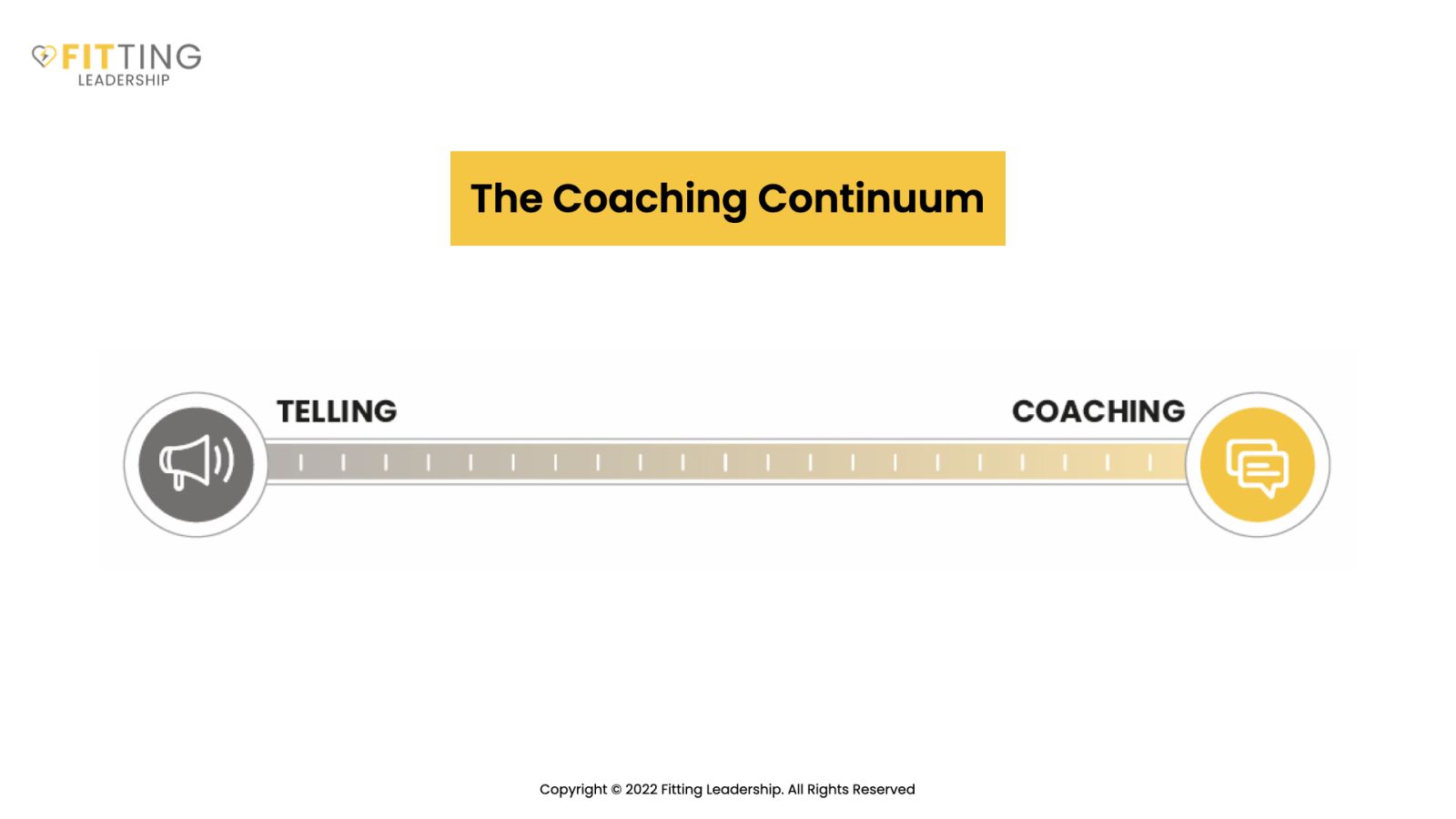
It is this that allows ownership to be transferred across.
For example:
You are speaking to your Dental Practice Manager about obtaining more reviews. You might believe you know the best way to achieve this and may feel compelled to instruct your Practice Manager on what to do. Instead, outline the overall objectives you wish to accomplish, which is to increase the number of reviews, and then ask the Practice Manager how they plan to approach this. You could pose questions such as:
- What do you think are the best ways of doing this?
- What are we doing currently?
- What would be a specific goal we could look to achieve?
- When do you think we can do this by?
- How can you go about doing this?
They generate ideas, making them more likely to feel ownership and accountability.
Commitment
All the things we have already discussed will help ensure that there is real commitment to do the task and be accountable for it.

Creating a safe environment where team members feel like they can challenge and voice their concerns about something. This allows concerns to be addressed and for their to be open debate. From this there can be an agreement to move forward. A commitment to move forward even if not everybody agrees. This is because at least their voice has been heard.
Clarifying expectations. This is very important when a decision has been made that not everybody agrees with. Sometimes, those people who disagree may feel a little bit disappointed, and you may feel relief at getting an agreement. This will lead to you wanting to move on fairly swiftly.
At this moment, you must clarify expectations of what is required of everybody on the back of this decision. To get real commitment to specific actions, and who is responsible for what, with clear time frames.
Transferring ownership. This helps create commitment as it is their idea.
Follow-Up
One of the ways to increase commitment is to make sure that there is follow-up.
At the time of the discussion. Agree on a time and location to follow up on the discussion. This lets the person know that there will be follow-up so they will have somebody holding them accountable.
Ensure you carry out the follow-up. It is easy to let this slip or to forget to follow up. Perhaps there is no record of what was agreed upon. All these factors assist you in managing the follow-up effectively.
Personality
When it comes to commitment, I think we also have to think about people’s natural personality types and differ in follow-up according to the individual.
Some people really enjoy and are very good at coming up with lots of great new ideas and suggestions. They love new projects. They can get easily bored. Perhaps they are wanting to people please and take on too much. These natural personality traits can mean that they are not so good on following through and getting things done. With these type of people you will probably want to put in tighter and more frequent follow up.
Other people are very good at following through and doing. Less about the new ideas. These people may be a bit offended if you start following up closely and being right on top of them when you have witnessed them consistently doing what they agreed to do in the past.
Giving Feedback

You have to set the example
The starting point for this is you! You have to set the example. As the leader, how accountable are you? When you say you will do something, do you do it? If you are not being accountable yourself, creating a culture of accountability will be very difficult. Read the previous article about accountability. Take a good look at yourself and ensure you set the example of being accountable.
You to team members
You have to give effective feedback to team members in your dental practice when you see examples of individuals being accountable or not being accountable. As you see them, give that feedback to the individual. Make sure it is balanced. You probably have a tendency one way or the other. Either to pick up more on when it isn’t happening and not recognise when it it. Or you pick up when it is happening and avoid the confrontation when it isn’t.
Do not let things slide.
See a previous article I wrote on giving effective feedback.
Team members to other team members
The ultimate goal is for team members to begin holding each other accountable when tasks are not completed as agreed. Therefore, it shouldn’t only be you, as a leader, who is taking responsibility; rather, everyone should be doing it amongst themselves. To reach this point, you as the leader must lead by example, but you can start encouraging others to adopt this behaviour by:
- Encouraging them to speak directly to a colleague rather than coming to you when a colleague hasn’t done something
- Training them in how to have that conversation and give that feedback
- Recognising and giving positive feedback to individuals when they do this
Conclusion
Cultivating a culture of accountability can significantly transform your dental practice and ensure you are always progressing, improving, and advancing towards your future vision. Consider these five strategies to achieve this:
- Create a psychologically safe environment
- Develop clear expectations
- Transfer ownership
- Ensure commitment
- Give feedback
Take the Dental Practice Leader Scorecard to learn where you can improve your leadership and receive a FREE copy of my book, Lead Your Dental Practice!