
Have you ever noticed something in your dental practice that needed addressing — the way someone spoke to a patient, a late arrival, or a moment that didn’t reflect the standard you expect in your practice? You know you should say something, but you hesitate because you do not want to create unnecessary tension. Or you raise it straight away, only to be met with defensiveness and a difficult atmosphere for the rest of the day. This is where a culture of feedback becomes so important. The question is: how do you create one in your dental practice?
Why?
The obvious reason that creating a culture of feedback is so important is that it enables you to continually improve the performance of everybody in the practice. Without feedback this is very hard to do and performance will not only stagnate but most likely decline. There are some other perhaps less obvious reasons why it is so important:
- Prevents resentment build up. If we don’t give feedback and the behaviour continues resentment can build up.
- Reduces destructive conflict. By giving the feedback we prevent the resentment build up, which often leads to feedback giving in a way that is ineffective and can lead to destructive conflict.
- Reduces secret conversations. If honest conversations are not being had, they will be going on behind closed doors instead.
- Open & honest culture. By encouraging feedback you are creating a culture where people know it is ok to be open and honest about what is happening.
- Inspires & creates energy. Negative feedback given well can inspire and give energy, as of course can positive feedback.
Two sides to the coin

There are two sides to the coin when it comes to giving feedback. In order to be able to give feedback you have to be able to receive it. If you cannot receive feedback well, then how can you expect your team to receive feedback well? You have to set the example.
Receiving

Feedback helps you to improve. When it comes to receiving feedback it can help to remember that feedback is one of the best ways of enabling you to improve. Without feedback you could be missing something that others are seeing.
You don’t have to act on it. Contrary to what you may feel, It doesn’t mean you have to do it. Sometimes I think people don’t listen and understand the feedback because they feel like they have to do it. Actually, the most important thing from my side is that you listen and understand the feedback. It is then up to you as to what you do with it.
Create a holding statement. To help prevent a defensive response, create a holding statement such as ‘I think you are giving me some feedback, which I really want to understand. Please can you repeat what you said and give me some more detail?’
Giving

Principles
Here are a few principles when it comes to giving feedback:
- Be able to articulate the issue
- Clear is kind, unclear is unkind
- Know your boundaries
- Be in an appropriate state
- Address as soon as possible after the situation
- Be empathetic in your tone and intent
- Give the feedback in an appropriate location
- Focus on the specific situation rather than generalisations and judgements
Structure
Use the following structure for your conversation:
- Ask for permission
- What you noticed/observed
- Impact
- Engage in dialogue
- Way forward
After
You have to make sure you follow up and keep following up and going back around until you see the change you want to see. Always set a follow up meeting date so the individual knows you will be coming back to this to ensure there is some change. Look out for the desired behaviour and recognise it if you see it.
Finding the Balance

One of the most important things with feedback is that you find a way to create a balance of positive and negative feedback. Previously people used to say that you gave good feedback followed by bad and then good. We all know the type of sandwich this is known as!
This doesn’t work and I have often heard people say you should give some good feedback first and then hit them with the bad. Does anybody remember the good when you do that? No!
I believe you give the feedback as you see it and only the good or only the bad.
When you see something bad, use the structure above to give them that negative feedback.
When you see something good, also use the structure above to give them the great feedback! It is very impactful and they will remember it.
The best leaders to both, separately.
Culture
Feedback needs to go in all directions. Associate to Principal. Principal to Practice Manager. Nurse to Principal. Nurse to Nurse. .Use the same principles and structure for all the conversations. When everybody gives feedback to everybody, you really start to create a culture of feedback.
Impact on your dental practice
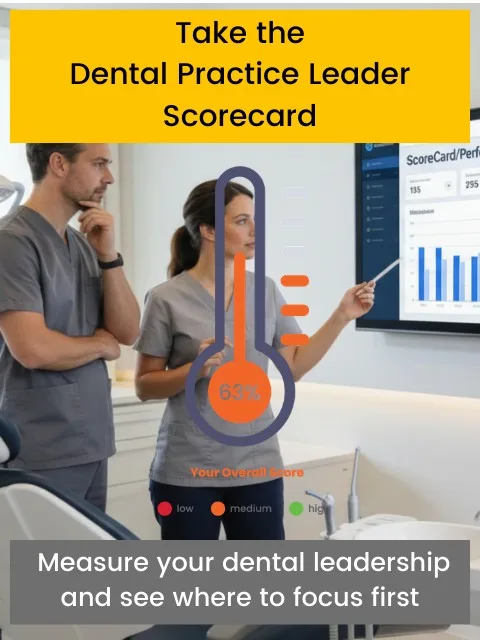
Creating a culture of feedback does not happen by accident. It starts with the way leaders model it, the conversations they are willing to have, and the consistency with which they follow through. If you want to understand where you are already strong and where there is still room to grow, the next step is to complete the Dental Practice Leader Scorecard. It will help you reflect on the leadership habits and behaviours that shape your team culture and give you a clearer picture of what to focus on next.