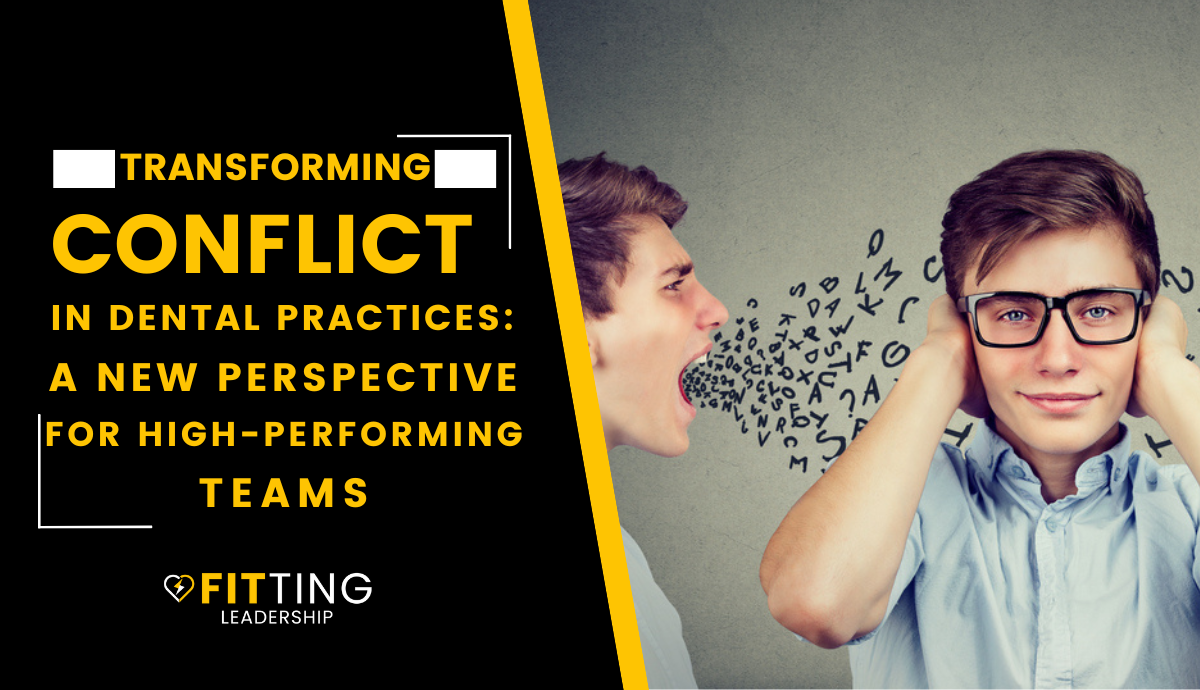
Have you ever felt the tension in your dental practice skyrocket due to unresolved conflicts? Are you keeping people apart by moving them into different surgeries?
Imagine turning these challenging moments into opportunities for growth and team excellence. Discover how a new perspective on conflict can transform your practice into a harmonious, high-performing team.
In order to create a high performing team it is essential to be able to have effective conflict. Patrick Lencioni in his book the Five Dysfunctions of a Team speaks to the importance of having effective conflict as being critical to success. Creating psychological safety is key for a high performing team as shown by the research carried out by Google during Project Aristotle and spoken about by Amy Edmonson in her book the Fearless Organisation. In this environment people can engage in debate and have disagreement without fear of inter-personal consequences.
Conflict is to be embraced rather than avoided. It allows your team and practice to grow and develop.
In this blog post I will give a new perspective on conflict and some actionable techniques for transforming conflict into opportunities for team growth and high performance.
Understanding Conflict in Dental Practices

Common Sources of Conflict
- Differences in work styles and personalities. We are all different. This is a combination of nature in terms of our genetic makeup and nurture in terms of the different upbringing and lives we have had and our having. This means we all behave differently. If people are at pole opposite ends of different personality styles this can lead to conflict. For example, even something like the place at which people can operate can be wildly different. This can be very frustrating for both. A high paced person being frustrated with how slowly things are done whilst a slower paced person left angry at how quickly the fast paced person will do stuff without taking time to reflect.
- Difference of opinion on a specific point of approach as to how things should be done. When there is a difference of opinion on something between 2 people this can escalate into a big deal. It may be that these individuals feel very strongly about that specific point. Perhaps because they feel threatened by the consequences of that decision of excited by the consequences of that decision. They can both feel very strongly about it and then it develops into a big issue. It is possible that it can then evolve into those individuals trying to gain support for their view with others, which starts to create a split in the team with more time spent on winning people internally than on trying to move the business forward.
- Role and responsibility ambiguities. When there is a lack of clarity around roles and responsibilities this can lead to conflict. Where one person does something which the other person feels should be their job the person can see this as interference or even that they are trying to take over their job. Whilst we want people to fill in where necessary it is very important that everybody is clear on their own areas of responsibility.
- Stress and high-pressure situations. When things get tense, when the clinics are extremely busy or perhaps there is a very demanding patient, people’s nervous systems become much more activated and we sit more in fight or flight mode. As a result we will tend to argue (fight) or shut down (flight) more in those situations when something has occurred that we don’t like
Impact of Unresolved Conflict
- Decreased team morale and productivity. Ineffective conflict can become very wearing. It is draining because you feel like it is constantly around. It doesn’t allow you to be able to fully focused on moving the business forward. People become very distracted from activities that can move the practice forward and instead focus on the conflict. People also start ‘treading on eggshells’ which means that you cannot discuss difficult issues and so you cannot move them forward and make progress. You also end up rearranging how you would work to keep these people away from each other even if it is not the most efficient and effective way of doing things.
- Increased staff turnover. Inevitably staff turnover will increase. It maybe that the conflict between those individuals will lead to one or both of them leaving. Due to the overall morale within the practice this could well lead to others leaving as well. It is not a great environment when there is unresolved conflict so people could leave as a result
- Poor patient experience and satisfaction. This will affect the experience for the patient. It is possible that there are direct interactions which are picked up and observed by patients which leads to a poor patient experience. Patients will also pick up when there is an uncomfortable atmosphere, even subconsciously. Team members are distracted by the conflict rather than on providing a great experience for the patients.
A New Perspective on Conflict

Viewing conflict as a good thing
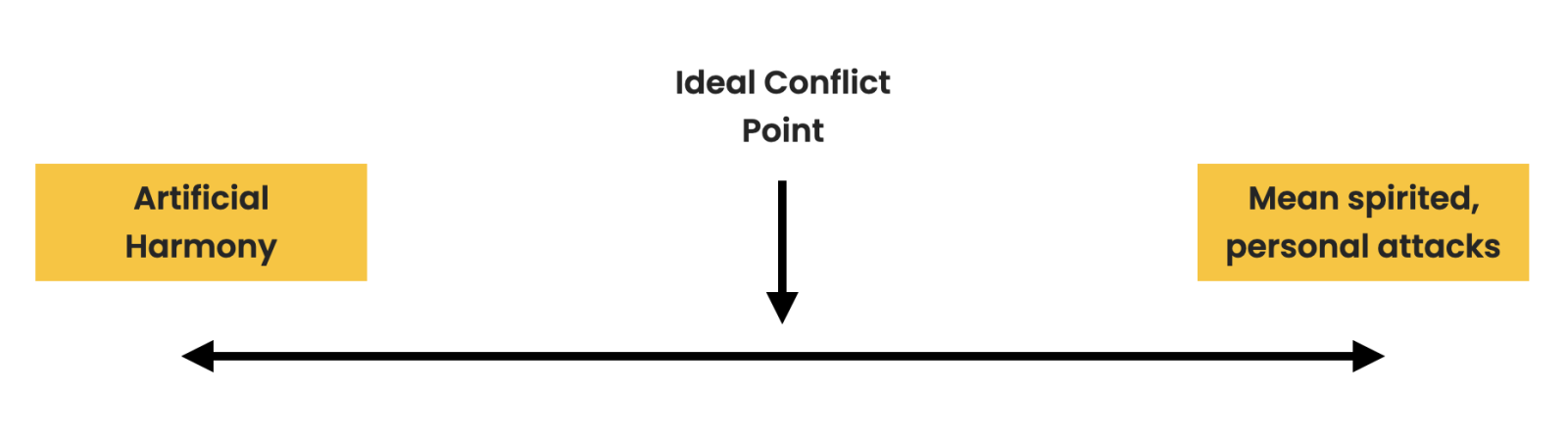
- Highly effective teams have conflict. In any team with different personalities and values there will always be a level of conflict present. If there doesn’t appear to be any on the surface it will be there but either it is not being expressed or it is being expressed in secret closed door conversations. Whilst you do not want mean personal conflict you also do not want artificial harmony. You want to find the ideal conflict point in the middle.
- Learning how to have effective conflict is very good for a team. It allows you to debate issues and discuss them openly. This means issues aren’t held back or left simmering so that they come out in a destructive and unhelpful manner. Ultimately it enables you to grow and develop as a practice.
The Role of Emotional Intelligence
- Understanding and managing emotions during conflict. We all have helpful & unhelpful behaviours during conflict. It is important to recognise what those are for you and to develop an awareness of your helpful and unhelpful behaviours during conflict as well as recognising what those are for others. As an example your helpful behaviour may be that you are good at showing empathy whilst your unhelpful behaviour may be the you tend to gloss over problems. Understanding our emotions and the emotions of others helps us step back from them, to not get caught up in them and to effectively resolve the conflict.
- Building empathy and genuinely listening. We can get very caught up in our own feelings and beliefs on a specific topic or situation. It is important to genuinely listen. To demonstrate empathy and put yourself in the shoes of the other person.
Effective Conflict Resolution Techniques

Open, Honest & Direct Communication
- Encouraging adult to adult behaviour. When somebody comes to you as the manager expressing concerns about another person encourage them to talk directly to that person.
- Creating a safe space for team members to express concerns. Give time and space for team members to bring up concerns. Don’t shut people down. If you don’t have time say that you want to listen and arrange a later time to speak.
- Active listening and clear communication.
Structured Problem-Solving
- Identifying the root cause of the conflict if it has escalated. Bring people together to openly talk about the issue.
- Avoid taking sides and watch out for confirmation bias in terms of your perceived views on people. Search out for specific facts and examples.
- Ask those involved to come up with solutions as to how to move things forward.
- See it through to resolution. Do not let it continue on. Keep moving it forward and taking appropriate steps until it is resolved.
Mediation and Facilitation
- Be the mediator. If there is a conflict between 2 people that continues then you may have to step in to mediate. This could be in the form of bringing them into a meeting together with you in the room. If you are too close to it you may have to bring in a neutral third party who is appropriately skilled.
- Lay out what you have noticed and reinforcing the importance of your expectations in terms of people working together.
- Set ground rules for the mediation for respectful communication.
- Give each each person the opportunity to speak and encourage them to speak to each other in turn, rather than to you.
- Clarify the issues and identify common interests.
- Brainstorm with the individuals to find a way forward. Clarify andgain commitment from the individuals with specific actions.
- Agree a time and location to follow up and reflect on progress.
Setting Clear Expectations and Boundaries
- Clarifying team norms. Set your expectations of people communicating directly and honestly.
- Clarify roles and responsibilities. Ensure it is clear who is responsible for what. This will require looking at broader areas of responsibility to provide that clarification and identifying any areas of potential overlap or confusion.
- Regular check-ins to ensure alignment and address issues early. Team meetings to openly discuss and reflect on how the team is engaging in conflict.
Conclusion
To transform conflict within dental practices we have to view conflict from a totally different perspective, namely that conflict at a certain level is not only to be expected but is required in order to have a high performing team. When done correctly it prevents destructive conflict because things are not being left unsaid which eventually leads to an eruption and unhelpful conflict.
Encouraging open, honest and direct communication allows us to create an environment where good conflict can take place which allows everything to continually move forward and improve.
Encourage differences and conflict to be aired so that everything can progress.